This chapter explains how to design tenants, users, L-Platforms, and servers.
Figure 1.1 Tenant/user/L-Platform/server configuration
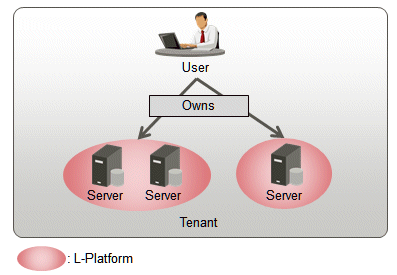
A tenant is a unit of management for segmenting and isolating the management and operation of resources, based on an organization or business.
Tenants are comprised of the following three resources:
Server
L-Platform
User (tenant administrator, tenant user)
Servers in a tenant are grouped according to the system operated by the business using the L-Platform. Users belonging to a tenant are managed collectively on the server for each L-Platform. Tenant users can manage servers within the L-Platform to which they belong. Tenant administrators can manage all servers within the tenant.
Decide on the configuration of tenants and L-platforms according to the following:
Points to note when deciding on the configuration of tenants
Zero or more users (tenant users or tenant administrators) can belong to a tenant, but each user (tenant user or tenant administrator) can belong to only one tenant.
Multiple L-Platforms can belong to a tenant, but each L-Platform can belong to only one tenant.
Points to note when deciding on the configuration of L-Platforms
Multiple servers can belong to an L-Platform, but each server can belong to only one L-Platform.
An L-Platform cannot belong to multiple tenants.
Select one user from the tenant administrators or tenant users as the L-Platform owner. A user can own multiple L-Platforms.